
- Residential Energy Storage Program Products
- Energy storage systems - ESS
- Batteries
- Battery chargers
- Power supplies
- Uninterruptible power supplies - UPS
- Inverters
- DC-DC converters
- Network devices
- Line filters
- Solar systems
- Building automation
- Automotive energy
- Test & measurement
- Protection devices
- Transformers
- DC Power Systems
- Lighting technology
- Solar carports
- EMS controllers
- EV car chargers
- Energy metering
- Power generators
EV car chargers
EV Chargers — AC and DC Charging Solutions from Energom
Energom is a European power electronics distributor with over 18 years of experience in industrial and commercial electrical systems. Our EV charger portfolio includes AC wall-mounted chargers (commonly referred to as wallboxes), portable chargers, DC fast chargers (DCFC), and accessories — from 3.7 kW to 360 kW. We supply system integrators, charge point operators (CPOs), fleet managers, property developers, and hospitality chains with electric car chargers for projects of any scale.
AC Chargers — Wall-Mounted and Portable Solutions
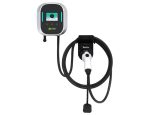
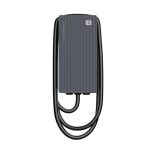
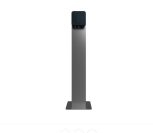
Wall-mounted chargers (Mode 3) are fixed-installation units with a Type 2 (IEC 62196) socket or integrated cable. Tethered wall-mounted EV chargers include a permanently attached cable — convenient for residential use. Untethered (socket-only) models are preferred for public and semi-public locations, as the user connects their own cable, reducing theft and vandalism risk. Power levels: 3.7 kW (single-phase, 1 × 16 A), 7.4 kW (single-phase, 1 × 32 A), 11 kW (three-phase, 3 × 16 A), and 22 kW (three-phase, 3 × 32 A). Most EVs have an 11 kW on-board charger (OBC), so a 22 kW wall charger does not charge them faster. The real value of 22 kW is versatility — it supports 3P 22 kW, 3P 11 kW, and 1P 7.4 kW. Many of our wall chargers include integrated DC 6 mA residual current protection per IEC 62955, eliminating the need for an external Type B RCD and saving EUR 200–400 per installation point.
Portable EV chargers (Mode 2) are not inherently limited in power. The factory-supplied Schuko cable delivers only 2.3 kW, but a portable charger with a CEE 32A three-phase connector reaches up to 22 kW — suitable as a home EV charger for travel or secondary locations. Fire safety note: Mode 2 charging is prohibited in many underground garages under European fire safety regulations; in such cases a Mode 3 wall charger is required.
DC Fast Chargers
Our DC fast chargers serve public charging networks, highway rest stops, commercial parking, hotels, and fuel station retrofits. In 2026, 50 kW is outdated for public EV charging stations — the standard is 150–240 kW for urban sites and 350–400 kW HPC for highway corridors. CCS Combo 2 is the European DC connector standard (CHAdeMO is legacy). All DCFC units support OCPP 1.6J and OCPP 2.0.1 for charge point management system (CPMS) integration.
Applications
- Residential: single-family homes, apartment complexes — 7.4 kW or 11 kW wall charger, overnight charging.
- Workplace: office buildings, manufacturing facilities — load balancing across multiple charge points.
- Commercial and hospitality: hotels, shopping centers — OCPP-enabled chargers for billing integration.
- Fleet management: delivery services, corporate fleets — OCPP 1.6J/2.0.1 CPMS integration, ISO 15118 Plug & Charge.
- Public networks: municipal and concessionaire operation — DC fast chargers, CCS Combo 2, contactless payment.
- EU-wide projects: Energom supplies EV chargers across Europe under standard Incoterms (EXW Budapest / DAP).
Why Source from Energom?
- Distributor and wholesale pricing: direct-from-manufacturer sourcing, volume discounts, project-based quotations.
- European stock: key models ship from our Budapest warehouse with EU-wide dispatch.
- Technical consultation: project planning, power dimensioning, grid compatibility assessment.
- Full portfolio under one roof: AC chargers, DC fast chargers, accessories, EMS controllers — single supplier.
- Standards compliance: IEC 61851, IEC 62196, IEC 62955, EN 61439-7.
- Reseller and installer partner program: structured channel partnership for recurring business.
Filter by power rating, charging mode, or application in the subcategories below. If you need project-level guidance, request a project quotation or schedule a technical consultation — our team will help you select the right EV charger configuration.

Frequently Asked Questions About EV Chargers
What is the difference between AC and DC EV chargers?
An AC electric car charger delivers alternating current to the vehicle, where the on-board charger (OBC) converts it to DC for the battery. Typical power: 3.7–22 kW, suited for residential and workplace use. A DC fast charger (DCFC) converts externally and feeds the battery directly at 30–360 kW, serving public networks and highway corridors. AC is simpler and cheaper to install; DC is faster but requires substantially more infrastructure and capital.
Which EV charger is best suited for home use?
A Mode 3 wall-mounted charger is recommended for daily home use — a Mode 2 portable charger is not intended for permanent installation. On a single-phase connection, maximum power is 7.4 kW. With three-phase supply, 11 kW (3 × 16 A) covers most EVs. A 22 kW unit adds versatility for future vehicles. Choose a model with integrated DC 6 mA protection (IEC 62955) to eliminate the external Type B RCD and save EUR 200–400 per point. A tethered (cable-attached) configuration is more convenient at home.
What is the difference between Mode 2 and Mode 3 charging?
Mode 2 is a portable charger with an in-cable control and protection device (IC-CPD). Power ranges from 2.3 kW on a Schuko outlet up to 22 kW on a CEE 32A three-phase connector — Mode 2 is not inherently limited in power. Mode 3 is a fixed wall charger with a Type 2 connector and integrated safety functions, delivering 3.7–22 kW for daily use. Important: Mode 2 is prohibited in many underground garages under fire safety regulations.
What charging power do I need: 11 kW or 22 kW?
The vehicle’s on-board charger (OBC) determines actual charging power, not the wall charger. Most EVs have an 11 kW OBC; only a few premium models — certain Porsche and Tesla variants — accept 22 kW AC. Connecting an 11 kW OBC vehicle to a 22 kW charger results in 11 kW actual power. The 22 kW unit’s value is versatility: it supports three-phase 22 kW, three-phase 11 kW, and single-phase 7.4 kW, and future-proofs the installation.
Why buy EV chargers from a distributor?
A distributor sources directly from manufacturers, delivering competitive pricing without retail markups. Services include project-level technical consultation — power dimensioning, grid compatibility, and load balancing design. Stock availability and short lead times support fast EU-wide shipping. A structured reseller and installer partner program enables recurring business, and direct manufacturer relationships ensure faster warranty resolution. Request a quotation for your next project.