
- Residential Energy Storage Program Products
- Energy storage systems - ESS
- Batteries
- Battery chargers
- Power supplies
- Uninterruptible power supplies - UPS
- Inverters
- DC-DC converters
- Network devices
- Line filters
- Solar systems
- Building automation
- Automotive energy
- Test & measurement
- Protection devices
- Transformers
- DC Power Systems
- Lighting technology
- Solar carports
- EMS controllers
- EV car chargers
- Energy metering
- Power generators
Uninterruptible power supplies - UPS
Uninterruptible Power Supplies (UPS) — Industrial and Commercial Power Protection
An uninterruptible power supply (UPS) bridges mains power disturbances — voltage sags, surges, brief or extended outages — ensuring continuous operation of connected loads. Energom's UPS portfolio covers both DC UPS modules and AC UPS systems, from DIN rail-mounted 12 VDC modules to three-phase online UPS systems rated at several hundred kVA. Our portfolio is built on products from Riello, Mean Well, TDK-Lambda, and NEXTYS. In our experience, the most common sizing error in industrial projects is failing to account for inrush current peaks of critical loads — expert sizing consultation eliminates this risk.
DC Uninterruptible Power Supplies
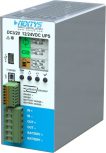
DC UPS modules provide uninterruptible power to DC loads across a 12–220 VDC output range. Typical applications: industrial automation (PLCs, I/O modules, sensors), telecommunications, fire alarm and access control systems, building management, and network equipment. The key advantage of DC UPS is that DC loads receive power directly, without an inverter stage — resulting in simpler architecture, higher efficiency, and true zero transfer time.

AC Uninterruptible Power Supplies (AC UPS)
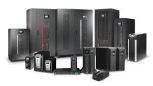
AC UPS systems protect mains-powered loads — server rooms, industrial production equipment, medical devices, office infrastructure — against power disturbances. Three main topologies exist: online (VFI, double-conversion), line-interactive (VI), and offline (VFD, standby). A detailed comparison of topologies is available on the AC UPS category page. Available in rack, tower, and modular form factors, in single-phase and three-phase configurations, from 300 VA to 800 kVA.
Riello AC UPS: For AC uninterruptible power supplies, we particularly recommend Riello solutions. In our experience, Riello units deliver consistently reliable performance, typically exceed their rated specifications, and their modular design makes maintenance fast and straightforward — a decisive factor in industrial environments where minimizing downtime is critical.
Temperature-Compensated Battery Charging
When selecting a UPS — whether DC or AC — it is important to verify that the integrated charger supports temperature-compensated battery charging. Over 25 years of field experience, we have found that temperature-compensated charging can extend battery service life by up to 50%. This is particularly critical in environments with wide temperature variation: outdoor enclosures, areas adjacent to production lines, or unheated industrial facilities.
DC UPS vs. AC UPS — Comparison
| Criterion | DC UPS | AC UPS |
|---|---|---|
| Output voltage | 12–220 VDC | 230 V / 400 V AC |
| Typical power range | 10 W – 10 kW | 300 VA – 800 kVA |
| Transfer time | 0 ms | 0 ms (online) / 2–4 ms (line-interactive) |
| Topology | Integrated charger + battery bypass | Online (VFI), line-interactive (VI), offline (VFD) |
| Form factor | DIN rail, panel-mount | Rack (19"), tower, modular |
| Typical application | PLC, sensor, fire alarm, telecom | Server, production equipment, medical, office |
| Energy storage | VRLA/AGM, Li-ion, supercapacitor | VRLA/AGM, Li-ion (model-dependent) |
Why Source UPS Systems from Energom?
- Authorized Riello distributor and service partner: full AC UPS range, service parts from stock, maintenance support.
- Technical consultation and sizing: load analysis, inrush current calculation, battery sizing, and backup time planning — backed by 25 years of field experience.
- Complete portfolio under one roof: DC UPS, AC UPS, UPS accessories, batteries, and power supplies — single supplier.
- European stock: key models ship from our Budapest warehouse with EU-wide dispatch under standard Incoterms (EXW Budapest / DAP).
- Proven manufacturers: Riello, Mean Well, TDK-Lambda, NEXTYS — reliability validated by industrial references.
Browse our DC UPS modules and AC UPS systems, or request a quotation for UPS system sizing.
Frequently Asked Questions About Uninterruptible Power Supplies
What is the difference between a DC UPS and an AC UPS?
A DC UPS provides uninterruptible power to DC loads (PLCs, sensors, fire alarms, telecom equipment), typically at 12–220 VDC. Its advantages include zero transfer time and simpler architecture. An AC UPS protects AC loads (servers, production equipment, office IT) at 230/400 V AC output, using online, line-interactive, or offline topology. The choice depends on the type of load being protected and the required level of protection.
How do I size an uninterruptible power supply?
UPS sizing is based on four key parameters: (1) total load power in VA or W, (2) inrush current peaks — motors, compressors, and power supplies can draw several times their rated current at startup, (3) required backup time in minutes or hours, (4) load characteristics (linear or non-linear). For complex systems and critical applications, expert sizing consultation is recommended.
Which UPS topology should I choose: online, line-interactive, or offline?
Online (VFI) UPS: 0 ms transfer time, pure sine wave output — recommended for servers, medical equipment, and industrial control systems. Higher power consumption and cost. Line-interactive (VI) UPS: 2–4 ms transfer, automatic voltage regulation, good efficiency — best value in the 1–3 kVA range. Offline (VFD) UPS: 4–8 ms transfer, basic protection for non-critical loads. The right choice depends on the protection requirements of the critical loads and the available budget. A detailed topology comparison is available on the AC UPS category page.
What battery types can be used with UPS systems?
VRLA/AGM (sealed lead-acid): the most common type, low maintenance, typically 3–5 years service life at 20 °C reference temperature. Li-ion (LiFePO4): 8–10 year service life, smaller size and weight, higher initial cost — supported by an increasing number of modern DC and AC UPS systems. Supercapacitor: short backup time (seconds), virtually unlimited cycle life, for specialized applications. Temperature-compensated charging is important for all three types to maximize service life.
How often does a UPS require maintenance?
VRLA batteries typically require replacement every 3–5 years (at 20 °C reference temperature). Without temperature compensation, every 10 °C increase roughly halves battery life (Arrhenius rule). Preventive maintenance is recommended annually: battery condition testing, fan and filter inspection, firmware updates. For online AC UPS systems, electrolytic capacitor replacement may be required every 7–10 years. As an authorized Riello service partner, Energom provides comprehensive maintenance support.