
- Residential Energy Storage Program Products
- Energy storage systems - ESS
- Batteries
- Battery chargers
- Power supplies
- Uninterruptible power supplies - UPS
- Inverters
- DC-DC converters
- Network devices
- Line filters
- Solar systems
- Building automation
- Automotive energy
- Test & measurement
- Protection devices
- Transformers
- DC Power Systems
- Lighting technology
- Solar carports
- EMS controllers
- EV car chargers
- Energy metering
- Power generators
DC UPS
DC UPS — Uninterruptible DC Power Supplies for Industrial Applications
A DC UPS (uninterruptible DC power supply) seamlessly takes over the supply of DC loads during mains voltage loss or instability — with 0 ms transfer time and no inverter stage. Energom's DC UPS portfolio spans from 12 VDC to 220 VDC, featuring modules from Mean Well, TDK-Lambda, and NEXTYS. In our experience, the vast majority of industrial projects require a 24 VDC DC UPS module — most PLCs, I/O modules, and industrial sensors operate on 24 VDC supply.
How Does a DC UPS Work?
A DC UPS consists of three functional blocks: (1) a mains power supply (AC/DC converter) that produces the required DC output voltage and simultaneously charges the battery, (2) a battery or other energy storage device (supercapacitor) that provides energy during a mains outage, and (3) a battery controller module that manages charging and seamless switchover to battery operation. Unlike an AC UPS, a DC UPS requires no inverter stage — the load receives DC power directly, resulting in simpler architecture, higher efficiency (typically 90–95%), and true 0 ms transfer time.
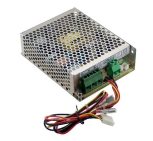
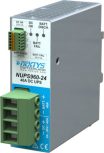
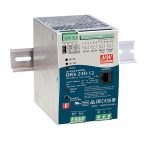
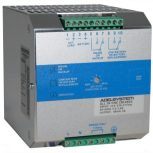
Output Voltage Range
The DC UPS module's output voltage determines which loads can be supplied. The following voltage levels are available:
- 12 VDC (44 products) — security systems (fire alarm panels, access control), CCTV cameras, small PLC systems, alarm equipment.
- 24 VDC (83 products) — industrial automation (PLCs, I/O modules, HMI panels, industrial sensors), building management systems (BMS), control systems. The widest selection.
- 36 VDC (10 products) — specialized industrial applications where 36 V system voltage is specified.
- 48 VDC (34 products) — telecommunications systems, PoE switches and access points, higher-power industrial systems, server-adjacent DC supply.
- 110 VDC (11 products) — power plant and substation auxiliary supply, industrial control systems, railway applications.
- 220 VDC (11 products) — high-reliability auxiliary systems, substation protection and control, critical industrial infrastructure.
DC UPS Selection Criteria
Selecting the right DC UPS module requires evaluating the following parameters:
- Output voltage: determined by the load's nominal supply voltage (12, 24, 36, 48, 110, or 220 VDC).
- Output power: the total power of connected loads — including inrush current peaks. As noted on our UPS overview page, the most common sizing error in industrial projects is failing to account for inrush current peaks.
- Required backup time: in minutes or hours, determined by battery capacity.
- Battery type: VRLA/AGM, Li-ion (LiFePO4), or supercapacitor — selected based on backup time, operating temperature, and service life requirements.
- Temperature-compensated charging: over 25 years of field experience, we have found that temperature-compensated charging can extend battery service life by up to 50%. This is particularly critical in outdoor enclosures, areas adjacent to production lines, and unheated industrial facilities.
- Mounting: DIN rail (the most common industrial form factor) or panel mount.
- Communication and monitoring: relay status outputs, RS-485, Modbus — remote monitoring is essential for critical applications.
Battery and Energy Storage Options
| Criterion | VRLA/AGM | Li-ion (LiFePO4) | Supercapacitor |
|---|---|---|---|
| Service life | 3–5 years (at 20 °C) | 8–10 years | 10–15 years (virtually independent of cycle count) |
| Backup time | Minutes to hours | Minutes to hours | Seconds (typically 5–30 s) |
| Operating temperature | -20…+50 °C (derate >25 °C) | -20…+60 °C | -40…+65 °C |
| Cycle count | 200–500 | 2,000–5,000 | >500,000 |
| Maintenance | Periodic replacement required | Minimal | Virtually maintenance-free |
| Typical application | General industrial, security systems | Extreme temperatures, long service life | Short backup, high cycle count |
Why Source DC UPS from Energom?
- Proven manufacturers: Mean Well, TDK-Lambda, NEXTYS — reliability validated by industrial references.
- Technical sizing consultation: load analysis, inrush current calculation, battery sizing, and backup time planning — backed by 25 years of field experience.
- Complete portfolio under one roof: DC UPS, AC UPS, UPS accessories, batteries, and power supplies — single supplier.
- European stock: key models ship from our Budapest warehouse with EU-wide dispatch under standard Incoterms (EXW Budapest / DAP).
Browse our subcategories by voltage: 12 V, 24 V, 36 V, 48 V, 110 V, 220 V — or request a quotation for custom sizing.
Frequently Asked Questions — DC UPS
What is the difference between a DC UPS and an AC UPS?
A DC UPS provides DC power directly to loads, typically in the 12–220 VDC range. It requires no inverter stage, resulting in 0 ms transfer time, simpler architecture, and higher efficiency (90–95%). An AC UPS delivers 230/400 V AC output using online, line-interactive, or offline topology, with an inverter stage. DC UPS is used for PLCs, sensors, fire alarms, and telecom equipment. AC UPS is used for servers, office IT, and production equipment.
Which output voltage should I choose for a DC UPS?
The output voltage is determined by the connected load. 12 VDC: security systems, CCTV. 24 VDC: industrial automation (PLCs, I/O, sensors) — the most common industrial voltage. 48 VDC: telecommunications, PoE switches. 110 VDC and 220 VDC: power plant and substation auxiliary systems. If the load accepts multiple voltages, 24 VDC offers the widest product selection.
What is the transfer time of a DC UPS?
A DC UPS achieves 0 ms transfer time (true uninterruptible operation). This is possible because the battery connects in parallel on the DC bus — during a mains outage, energy flows to the load instantly without switching. By comparison, an online AC UPS also achieves 0 ms, but a line-interactive AC UPS has 2–4 ms transfer time, and an offline AC UPS has 4–8 ms.
What battery types can be used with a DC UPS?
Three main types: (1) VRLA/AGM (sealed lead-acid): 3–5 year service life at 20 °C, the most common choice. (2) Li-ion (LiFePO4): 8–10 year service life, smaller and lighter, higher initial cost. (3) Supercapacitor: seconds of backup time but virtually unlimited cycle life, for specialized applications. Temperature-compensated charging is important for all types — over 25 years of field experience, we have found it can extend battery life by up to 50%.
How can I extend the battery life of a DC UPS?
The most important factor is temperature-compensated charging. Per the Arrhenius rule, every 10 °C increase above the 20 °C reference temperature roughly halves VRLA battery life. Compensated charging mitigates this effect. Additional measures: (1) avoid deep discharge — most DC UPS modules include built-in deep discharge protection, (2) maintain the recommended temperature range (ideal: 20–25 °C), (3) perform annual impedance testing, (4) replace the battery at the manufacturer's recommended interval rather than waiting for complete capacity loss.