
- Residential Energy Storage Program Products
- Energy storage systems - ESS
- Batteries
- Battery chargers
- Power supplies
- Uninterruptible power supplies - UPS
- Inverters
- DC-DC converters
- Network devices
- Line filters
- Solar systems
- Building automation
- Automotive energy
- Test & measurement
- Protection devices
- Transformers
- DC Power Systems
- Lighting technology
- Solar carports
- EMS controllers
- EV car chargers
- Energy metering
- Power generators
DC-DC converters
DC-DC Converters — Industrial DC Voltage Conversion
A DC-DC converter transforms one DC voltage level into another — the output voltage can be lower (buck), higher (boost), or regulated in both directions (buck-boost) relative to the input. Energom's DC-DC converter portfolio comprises over 3,300 products, from 3 W to 2,780 W, sourced from six manufacturers: Mean Well, TDK-Lambda, Victron Energy, Enedo, NEXTYS, and Adel System. In our experience, the most common design error in DC-DC converter selection is overlooking the full input voltage range — in battery-powered systems, the voltage can vary by 30–40% from the nominal value depending on the state of charge.
How Does a DC-DC Converter Work?
A DC-DC converter is a switched-mode circuit: it chops the input DC voltage at high frequency (typically 100 kHz – 1 MHz), stores energy in an inductor or transformer, and delivers it at the desired output voltage level. This principle yields 85–97% efficiency — compared to 30–60% for linear regulators. In galvanically isolated types, the transformer also provides galvanic separation between input and output (typically 1.5–6 kV isolation voltage), which is critical for both safety compliance and common-mode noise rejection.
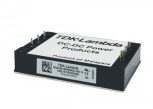
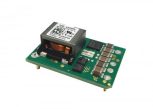
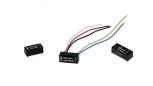
Isolated vs. Non-Isolated (POL) Converters
DC-DC converters fall into two main categories: galvanically isolated and non-isolated (POL — Point-of-Load). The choice depends on the application's safety and noise immunity requirements:
| Criterion | Galvanically isolated | Non-isolated (POL) |
|---|---|---|
| Galvanic isolation | Yes (1.5–6 kV) | None |
| Typical efficiency | 85–93% | 90–97% |
| Size | Larger (transformer required) | More compact |
| Relative cost | Higher | Lower |
| Typical application | Medical, industrial, telecom, railway | Board-level voltage regulation, digital circuits |
| Noise rejection | Excellent (common-mode rejection) | Basic |
| Input/output grounding | Independent (isolated) | Common |
Subcategories
Our DC-DC converter portfolio is organized into three subcategories:
- Isolated DC-DC converters (3,058 products) — transformer-based galvanic isolation, 1.5–6 kV isolation voltage. PCB (brick format), DIN rail, and panel mount. Applications: industrial automation, medical equipment (IEC 60601), telecommunications, railway systems (EN 50155).
- Non-isolated / POL DC-DC converters (228 products) — Point-of-Load voltage regulators mounted close to the load on the PCB. Typical output range: 3.3–30 V, up to 14 A output current.
- LED driver DC/DC converters (107 products) — constant-current output for LED string driving. Mean Well LDD, NLDD, and LDH series. PWM and analog dimming support.
Selection Criteria
Selecting the right DC-DC converter requires evaluating the following parameters:
- Input voltage range: the full operating range, not just the nominal value. For battery-powered systems, the discharge curve must be considered (e.g., 12 V lead-acid battery: 10.5–14.4 V range).
- Output voltage and current: determined by the load's nominal supply voltage and maximum current draw.
- Power rating: sized by output power (W), accounting for peak load conditions. Our range spans 3 W to 2,780 W.
- Galvanic isolation: is input-output isolation required? If so, what isolation voltage (1.5 / 3 / 4 / 6 kV)?
- Efficiency: higher efficiency = less heat dissipation = reduced cooling requirements. This is a critical factor in sealed enclosures and natural convection designs.
- Package and mounting: PCB mount (brick format: 1/32 to full brick), DIN rail mount (industrial cabinets), or panel/chassis mount (higher power).
- Operating temperature: industrial range is typically -40 to +85 °C. In extreme environments, derating curves must be applied.
- Certifications: medical (IEC 60601), railway (EN 50155), marine, military — determined by the application requirements.
Manufacturers
Six manufacturers spanning the range from cost-effective to premium industrial grade:
- Mean Well — the largest share of our portfolio. Industrial and LED driver series (SD, DDR, DDRH, RSD, LDD, LDH). Excellent price/performance ratio, 3–5 year warranty.
- TDK-Lambda — premium industrial and medical grade. i-series POL modules, isolated brick converters. Outstanding reliability and documentation.
- Victron Energy — Orion series, primarily for mobile, marine, and off-grid applications. Conversion between 12/24/48 V system voltages.
- Enedo — telecom and industrial converters, wide input range, high power density.
- NEXTYS — DIN rail-mounted industrial converters, robust construction.
- Adel System — DIN rail-mounted converters for industrial automation.
Why Source DC-DC Converters from Energom?
- Authorized Mean Well and TDK-Lambda distributor: direct manufacturer support, full product range, and technical assistance.
- Over 3,300 products: isolated, POL, and LED driver types — one of the widest DC-DC converter selections available from a single European source.
- Technical sizing support: input voltage range, power rating, isolation, package, certifications — we assist with selecting the right converter for your application.
- European stock: key models ship from our Budapest warehouse with EU-wide dispatch under standard Incoterms (EXW Budapest / DAP).
Browse our subcategories: isolated, POL, LED driver — or request a quotation for application-specific selection.
Frequently Asked Questions — DC-DC Converters
What is the difference between an isolated and a non-isolated (POL) DC-DC converter?
An isolated DC-DC converter contains a transformer that electrically separates the input and output sides, providing 1.5–6 kV isolation voltage. This is essential for safety compliance and common-mode noise rejection in medical, telecom, and railway applications. A non-isolated (POL) converter is more compact, less expensive, and more efficient (90–97%), but provides no galvanic isolation — it is typically used for board-level voltage regulation where input and output share a common ground.
How do I choose between Buck, Boost, and Buck-Boost topology?
The topology depends on the relationship between input and output voltage. Buck (step-down): output voltage is lower than input — this is the most common type. Boost (step-up): output voltage is higher than input, used for example to step up battery voltage. Buck-Boost: output can be higher or lower than input, required when the input voltage range spans above and below the desired output — for example, when battery voltage varies with state of charge across the target output level.
What is the difference between a DC-DC converter and an AC/DC power supply?
A DC-DC converter transforms one DC voltage level into another (DC input → DC output). An AC/DC power supply converts mains AC voltage (230 V AC) into DC voltage (AC input → DC output). If the system has a mains connection, an AC/DC power supply is needed. If the system already operates on DC (battery, solar panel, DC bus) and a different voltage level is required, a DC-DC converter is the correct choice.
What efficiency can a DC-DC converter achieve?
Switched-mode DC-DC converters typically achieve 85–97% efficiency. Non-isolated (POL) types are more efficient (90–97%), while galvanically isolated types achieve 85–93%. For comparison, linear regulators achieve only 30–60% efficiency. Higher efficiency means less heat dissipation and reduced cooling requirements — a critical factor in sealed enclosures and natural convection designs.
What package types are available for DC-DC converters?
Three main mounting types are available: (1) PCB mount — brick-format modules soldered directly onto the printed circuit board (standard sizes: 1/32 to full brick). (2) DIN rail mount — the most common industrial form factor, for control cabinets and distribution panels. (3) Panel/chassis mount — for higher-power applications, with screw mounting. The choice depends on the application environment and power requirements.