
- Residential Energy Storage Program Products
- Energy storage systems - ESS
- Batteries
- Battery chargers
- Power supplies
- Uninterruptible power supplies - UPS
- Inverters
- DC-DC converters
- Network devices
- Line filters
- Solar systems
- Building automation
- Automotive energy
- Test & measurement
- Protection devices
- Transformers
- DC Power Systems
- Lighting technology
- Solar carports
- EMS controllers
- EV car chargers
- Energy metering
- Power generators
AC chargers
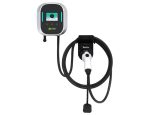
AC EV Chargers — Wall-Mounted and Portable Charging Solutions
AC chargers deliver alternating current to the vehicle, where the on-board charger (OBC) converts it to DC for the battery. Power levels range from 3.7 kW to 22 kW, covering residential, workplace, and semi-public applications. Energom's AC charger portfolio includes wall-mounted chargers (Mode 3) and portable chargers (Mode 2), sourced from established manufacturers and stocked at our Budapest warehouse for EU-wide dispatch. In our experience, B2B clients — installers, industrial facilities, and property managers — predominantly specify three-phase wall-mounted chargers: they cover the widest range of vehicle requirements, and suitable three-phase supply is typically already available at these sites.
Wall-Mounted AC Chargers (Mode 3)
Wall-mounted chargers are fixed-installation Mode 3 units with a Type 2 (IEC 62196) socket or integrated cable. Tethered models include a permanently attached cable — convenient for residential and restricted-access sites. Untethered (socket-only) models suit public and semi-public locations, reducing theft and vandalism risk. Power levels: 3.7 kW (1 × 16 A), 7.4 kW (1 × 32 A), 11 kW (3 × 16 A), and 22 kW (3 × 32 A). Actual charging power is always determined by the vehicle's on-board charger (OBC) — most EVs are equipped with an 11 kW OBC.
Smart features: Selected models in our range include RFID authentication, WiFi or 4G connectivity, OCPP 1.6J protocol support, and dynamic load balancing (DLB). For industrial and workplace projects, dynamic load balancing is the most frequently requested feature in our experience — it enables multiple charge points to operate within the building's existing connection capacity without a grid upgrade. In multi-tenant and commercial environments, OCPP-based backend integration is essential for consumption tracking and cost allocation.
Integrated DC 6 mA protection (IEC 62955): Many of our wall chargers include built-in DC residual current detection. This eliminates the need for an external Type B RCD in the electrical panel, saving EUR 200–400 per installation point.
Tested reliability: We test Zencar AC chargers in our workshop before adding them to the portfolio — verifying that overcurrent, overvoltage, and residual current protections operate correctly. Feedback from both installer partners and end-user clients confirms that Zencar wall chargers are quick and straightforward to commission — in larger-volume rollouts, this translates directly into lower installation cost per point.
Portable AC Chargers (Mode 2)
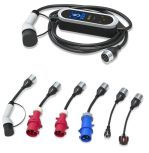
Portable chargers operate in Mode 2 with an integrated IC-CPD (In-Cable Control and Protection Device). Power depends on the connector: 2.3 kW from a Schuko outlet, 3.7 kW from a CEE 16 A single-phase, and up to 22 kW from a CEE 32 A three-phase connector. Typical applications: travel, secondary locations (holiday homes, remote work sites), and industrial facilities without fixed charging infrastructure.
Fire safety note: Mode 2 charging is prohibited in many underground garages under European fire safety regulations. For fixed, daily charging, a Mode 3 wall-mounted charger is required.
Wall-Mounted vs. Portable — Comparison
| Criterion | Wall-Mounted Charger (Mode 3) | Portable Charger (Mode 2) |
|---|---|---|
| Installation | Fixed, wall-mounted — electrician required | No installation — plug into existing outlet |
| Power range | 3.7–22 kW | 2.3–22 kW (CEE 32A three-phase) |
| Grid-side connector | Hardwired / fixed connection | Schuko, CEE 16A, CEE 32A |
| Smart features | RFID, WiFi/4G, OCPP, DLB — model-dependent | Typically none or limited |
| Daily sustained use | Yes — designed for continuous operation | Supplementary / travel use |
| Underground garage | Permitted | Often prohibited (fire safety) |
| Typical application | Home, workplace, hotel, industrial facility | Travel, holiday home, temporary site |
Why Source AC Chargers from Energom?
- Tested products: we test AC chargers in our workshop before adding them to the portfolio — protection functions are verified before a product goes live.
- Distributor and wholesale pricing: direct-from-manufacturer sourcing, volume discounts, project-based quotations.
- Technical consultation: power dimensioning, load balancing design, and grid compatibility assessment for multi-point projects.
- European stock: key models ship from our Budapest warehouse with EU-wide dispatch under standard Incoterms (EXW Budapest / DAP).
- Full portfolio under one roof: wall chargers, portable chargers, DC fast chargers, mounting poles, and accessories — single supplier.
Browse our wall-mounted AC chargers or portable chargers, or request a project quotation.
Frequently Asked Questions About AC EV Chargers
What is the difference between a wall-mounted charger (Mode 3) and a portable charger (Mode 2)?
A wall-mounted charger is a fixed-installation Mode 3 unit with a Type 2 connector, delivering 3.7–22 kW. It is designed for sustained daily use at homes, workplaces, and semi-public locations. A portable charger operates in Mode 2 with an integrated IC-CPD: power ranges from 2.3 kW on a Schuko outlet to 22 kW on a CEE 32A three-phase connector. Portable chargers suit travel and secondary locations. Mode 2 charging is prohibited in many underground garages under European fire safety regulations, so fixed daily charging requires a Mode 3 wall charger.
Do I need a three-phase power supply for an AC EV charger?
Not necessarily. On a single-phase connection, power reaches 3.7 kW (16 A) or 7.4 kW (32 A) — sufficient for overnight charging. With a three-phase supply, 11 kW (3 × 16 A) or 22 kW (3 × 32 A) is available, reducing charge time to 4–6 hours. Most EVs have an 11 kW on-board charger (OBC), so a three-phase 11 kW connection typically meets the requirement. For workplace and fleet installations with multiple charge points, three-phase supply is strongly recommended to enable load balancing.
What does integrated DC 6 mA residual current protection (IEC 62955) mean?
During EV charging, the vehicle's on-board charger (OBC) can generate DC fault current that a standard Type A RCD cannot detect. A charger with IEC 62955-compliant built-in DC 6 mA detection monitors this fault current internally, eliminating the need for a separate Type B RCD in the electrical panel. This saves EUR 200–400 per installation point — a significant cost reduction in multi-point projects.
What smart features are available in AC wall chargers?
AC wall chargers are available in basic and smart configurations. Smart features include: RFID card authentication (user separation and access control), WiFi or 4G connectivity (remote management and monitoring), OCPP 1.6J protocol support (integration with charge point management systems), dynamic load balancing / DLB (operating multiple charge points within the building's connection capacity), energy metering (consumption tracking), and scheduling (charging during off-peak tariffs). For commercial and workplace applications, OCPP-compatible models with load balancing are recommended.
How do I select an AC charger for a workplace or industrial site?
Key considerations for workplace and industrial installations: (1) Three-phase connection with 11 kW output — matches most EV on-board chargers. (2) Dynamic load balancing (DLB) — enables multiple charge points without upgrading the grid connection. (3) OCPP compatibility — the foundation for consumption tracking, cost allocation, and backend integration. (4) Socket-only (untethered) configuration — reduces cable damage risk with multiple users. (5) Integrated DC 6 mA protection (IEC 62955) — lowers per-point installation cost. For projects with 5 or more charge points, request a technical consultation for power dimensioning and load balancing design.